
FOUNDATION REPAIR
FIX IT ONCE.
FIX IT RIGHT.
Concrete pressed pile foundation repair for homes across League City, Pearland, Friendswood, and the Bay Area. Every job starts as an engineered drawing, gets reviewed by an independent engineering firm, and ends with verified elevation readings you keep.
Engineer-verified
Third-party firm checks our work
1–3 days on site
Most homes, start to finish
Lifetime transferable warranty
It follows the house, not you

WARNING SIGNS
DO YOU HAVE A FOUNDATION PROBLEM?
Foundation movement almost never announces itself with a dramatic crack. It shows up as a door that has started to stick, a hairline seam above a window frame, a floor that feels slightly off underfoot. Here’s what to look for — and what most of it actually means.
One or two of these on their own often mean nothing. Several at once, or any of them getting visibly worse over a few months, is worth an evaluation. It’s free, and most of the time we tell homeowners their foundation is fine.
Doors that stick or won’t latch.
Usually the first thing homeowners notice. As a slab moves, the frame racks slightly out of square and the door binds along one edge. If it’s seasonal — sticking in summer, fine in winter — that’s the clay cycle, and it’s worth watching.
Cracks above doors and windows.
Corners are stress points. Diagonal cracks running up and away from a door or window frame are far more meaningful than vertical hairlines in the middle of a wall.
Stair-step cracks in exterior brick.
Cracks that follow the mortar joints in a stepped pattern indicate differential movement — one section of the foundation has dropped relative to another. Width matters more than length.
Gaps between the wall and the ceiling or floor.
A crown molding pulling away from the ceiling, or a baseboard separating from the floor, means the two surfaces are no longer moving together.
Sloping or bouncing floors.
Set a ball on the floor in several rooms. If it consistently rolls the same direction, the slab has tilted. Bouncing usually points to something different and worth diagnosing separately.
Cracks in the slab or garage floor.
Hairline shrinkage cracks are normal in concrete and cure-related. Cracks where one side sits higher than the other, or that widen over months, are movement.
Separation at the fireplace or chimney.
Masonry is heavy and often sits on its own footing. A chimney pulling away from the exterior wall is a strong signal.
Windows that stopped opening.
Same mechanism as sticking doors, and often noticed later because the window gets used less.
Gaps around exterior door frames.
Daylight visible at a corner of a closed exterior door, or weatherstripping that no longer seals, means the frame has racked.
Plumbing you can’t explain.
An unexplained jump in the water bill, or a warm spot on the slab, can indicate a leak under the foundation — which is both a cause of movement and a reason to diagnose before repairing.
THE CAUSE
YOUR SLAB DOESN’T SINK. IT MOVES AT THE EDGES.
The most useful thing to understand about foundation movement in this part of Texas is that slabs rarely settle evenly. If a whole foundation dropped two inches uniformly, nobody would notice — no doors would stick, no brick would crack. What causes damage is differential movement: one part of the slab moving relative to another. And in gumbo clay, that difference is driven almost entirely by moisture.
The perimeter dries out faster than the center.
The soil around the outside edge of your slab is exposed to sun, wind, and whatever the weather is doing. The soil underneath the middle of the house is shielded, and it holds moisture far more consistently. During a hot, dry Texas summer, the perimeter clay shrinks and pulls down while the center stays supported. The slab edge drops. Come a wet spring, the perimeter swells and pushes back up. Your foundation is being flexed at the edges every single year.
Drought accelerates it dramatically.
Clay doesn’t shrink at a steady rate — it shrinks hard once moisture drops past a threshold. Which is why foundation calls in this region spike after a severe summer and why homeowners often describe damage appearing suddenly rather than gradually. The movement was building for years; the drought just pushed it past the point where the house could absorb it.
Trees pull moisture out from underneath.
A mature oak can draw a substantial volume of water out of the surrounding soil during dry months, and root systems extend well past the canopy. A large tree close to the house creates a localized dry zone under one section of the slab, which is why tree-side settlement is one of the most common patterns we see. Removing the tree isn’t usually the answer, and can sometimes make things worse in the short term.
Plumbing leaks work in the opposite direction.
A leaking supply line or sewer under the slab saturates clay that’s used to being relatively stable, which swells it and pushes that section of the foundation up. This produces damage that looks like settlement but has the opposite cause, and repairing the foundation without finding the leak means repairing it twice. If we suspect one, we’ll say so before we quote anything.
Poor drainage and inconsistent watering make all of it worse.
Downspouts emptying at the foundation, a yard that slopes toward the house, or irrigation that soaks one side while the other bakes — each of these widens the moisture difference between one part of the slab and another. Consistent perimeter moisture is genuinely the cheapest foundation maintenance there is, and it costs nothing to point out.
some of it is regional.
Parts of Harris and Galveston counties have measurably settled over decades, largely from groundwater withdrawal — enough that a regional district exists specifically to monitor it. It operates at a scale no homeowner can influence. It’s worth knowing because it means some movement here isn’t a construction defect or anyone’s fault.
THE METHOD
CONCRETE PRESSED PILE UNDERPINNING.
Underpinning means extending your foundation down to soil that doesn’t move. We do it with concrete pressed piles — the most widely used method for slab homes in this region, and not a proprietary system you can only buy from us.

1. Access and excavation
We dig access holes at the pile locations shown on your engineered plan, working from the exterior wherever possible. Landscaping is protected and set aside for replacement.

2. Piles pressed to refusal
Cylindrical concrete segments are hydraulically pressed into the ground one at a time, stacked as they go. The press uses the weight of your house itself as the reaction force, which means each pile is load-tested by your own structure as it’s installed. We drive to practical refusal — typically in the range of 6,000 to 11,000 psi — so the pile is bearing on soil that will actually hold it.

3. Lift to plan
With piles in place, we raise the foundation to the target elevations on the drawing, using shims and caps to lock each pile at its final height. This is where the plan earns its keep: we’re lifting to specified numbers, not to eyeball.

4. Backfill, verify, document
Access holes are backfilled and compacted, landscaping goes back. An independent engineering firm takes final measurements, and you receive before-and-after elevation readings alongside your warranty.
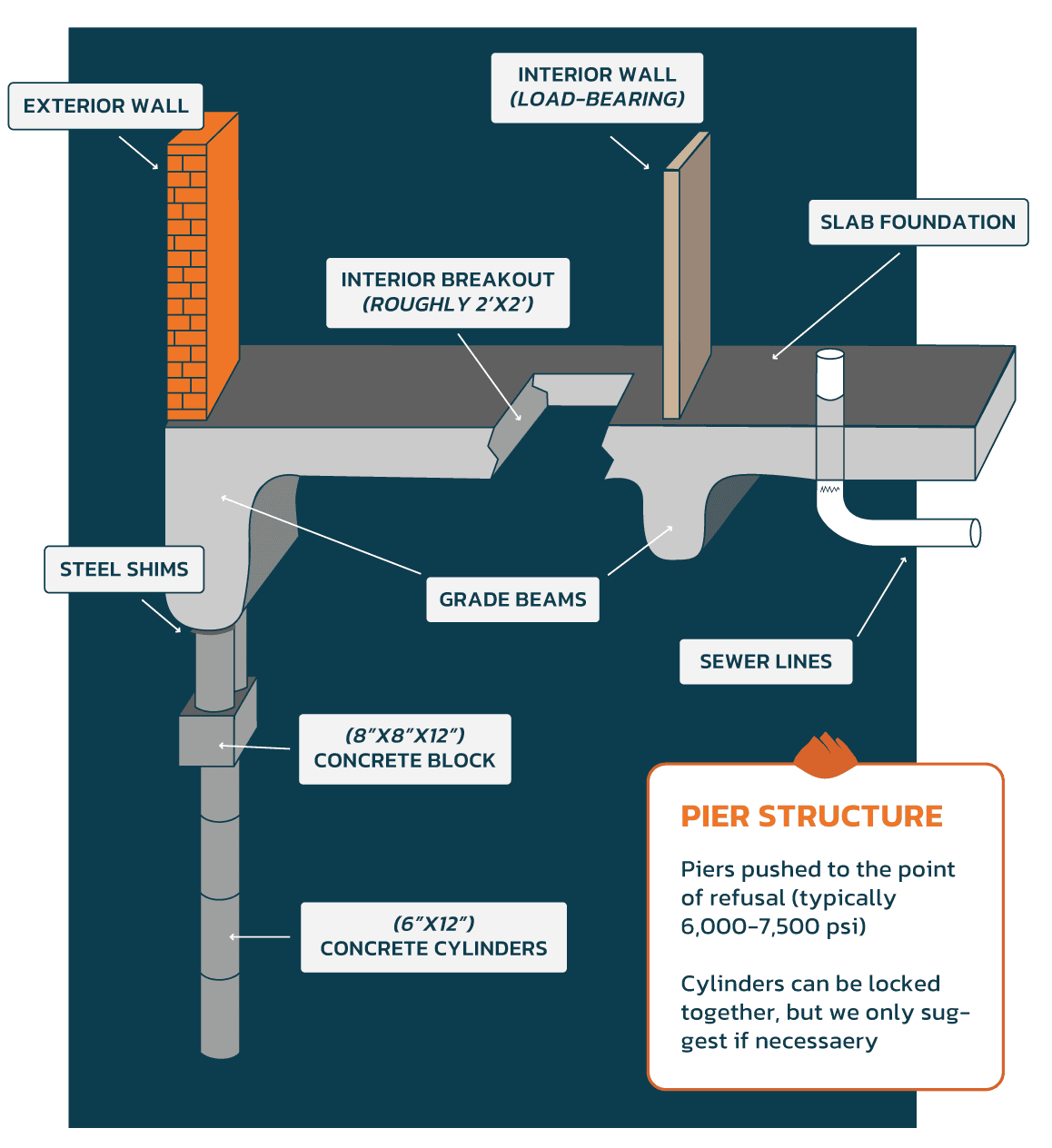
Why pressed piles.
Drilled and bell-bottom piers are poured in place and need days to cure before they can carry load. Steel piers cost considerably more and are generally reserved for unusual conditions. Concrete pressed piles are installed dry, carry load immediately, require smaller excavations, and use the house’s own weight as the installation force — which makes every pile a load test. For typical residential slabs on Gulf Coast clay, this is the method that does the job without the markup.
COST & TIMELINE
WHAT FOUNDATION REPAIR ACTUALLY COSTS.
We won’t quote you over the phone, because anyone who does is guessing. What we can tell you is what drives the number and what the range typically looks like.
We Offer financing
Investing in the stability of your home is important, but can sometimes be a hurdle for homeowners. Stretching that cost over time can help you get the repairs you need now so you and your family can trust the integrity of your foundation. Explore financing →

Number of piles
The main driver. Determined by how much of your foundation has moved and how far, not by square footage alone.

Access
Tight side yards, mature landscaping, decking, or a pool near the work area all add labor.

Depth to stable soil
Piles are driven to refusal. Where that depth sits varies across the region and even across a single lot.

What’s underneath
A suspected plumbing leak needs diagnosing before repair. We’d rather find it first than fix your foundation twice.
WHY DEEP ROCK?
WE DON’T ASK YOU TO TRUST US. WE PROVE IT.
Foundation repair is uniquely hard to evaluate as a homeowner, because the work goes underground and gets covered up. That’s why we built the process around leaving you evidence:
An engineered plan before we start
Your repair begins as a drawing — contour lines, target elevations, pile placement — not a one-page estimate. You see the whole plan before anyone touches your house, you keep a copy, and you’re free to take it to any other contractor for comparison.

A third party checks our work
An independent structural engineering firm reviews the plan before we begin and takes on-site measurements after we finish. We don’t grade our own homework, and you don’t have to take our word for the result.

A warranty that outlives your ownership
Our lifetime warranty covers the pressed piles we install and transfers to the next owner if you sell — which makes it a genuine asset at resale rather than a marketing line. If you notice movement, we re-evaluate at no cost.
FREQUENTLY ASKED QUESTIONS
QUESTIONS, AND STRAIGHT ANSWERS.
Including the ones most contractors avoid until they’re already standing in your living room.
How do I know if I actually need foundation repair?
You often don’t, and that’s the honest answer. Plenty of the cracks and sticking doors homeowners worry about are cosmetic or seasonal. The only way to know is elevation readings across the whole house, which is what our free evaluation provides. Most of the time we tell people their foundation is fine — and that’s worth knowing for certain rather than wondering about.
How much does foundation repair cost?
The cost is driven mainly by how many piles your home needs. We don’t quote over the phone because we’d only be guessing. After a free on-site evaluation you’ll have an engineered plan and a firm price, and you’re welcome to take both to another contractor.
How long does foundation repair take?
Most homes are finished in one to three days on site. Larger or more complicated jobs run longer, and we’ll tell you which yours is before you commit rather than after we’ve started.
What is foundation underpinning?
Underpinning means extending a foundation down to soil that can actually support it. For slab homes in this region we do that with concrete pressed piles — cylindrical concrete segments hydraulically pressed into the ground until they reach refusal, then used to lift the foundation back to its target elevations.
Do I have to move out during the repair?
No. Nearly all of our work happens outside the home, and most homeowners stay put throughout. You’ll hear equipment and see crews in the yard, but you won’t be displaced.
Will my cracks close up after the repair?
Many will close substantially as the foundation returns to elevation, but not all of them, and we won’t promise otherwise. Cosmetic repair of drywall, brick, and mortar is separate work that we don’t perform — we’ll tell you honestly what to expect once the lift is done.
Is your warranty really transferable?
Yes. It covers the pressed piles we install and transfers to the next owner if you sell the home. If movement appears, we re-evaluate at no cost. Full terms are on our warranty page.
Do you work on commercial buildings?
No. Deep Rock is residential-only. Specializing in homes is how we keep our crews consistent and our pricing where it is.
What areas do you serve?
We’re based in League City and serve League City, Pearland, Friendswood, Clear Lake, Dickinson, Alvin, Manvel, Sienna, Sugar Land, Missouri City, and surrounding communities across the greater Houston area.
START WITH A FREE EVALUATION.
We’ll take elevation readings across your whole house, tell you honestly whether it needs work, and if it does, hand you an engineered plan you can take to anyone. No cost, no obligation, no sales script — and a human answers the phone.
Call (281) 756-7301
REQUEST YOUR FREE EVALUATION
"*" indicates required fields